The $100,000 Question: Is the 20% Down Payment Dream Holding You Back?
For countless aspiring homeowners across Canada, there is one number that looms larger than any other: 20%. The idea that you must save a 20% down payment to buy a home has become so ingrained in our collective thinking that it often feels like an unbreakable law of real estate. In many of Canada’s housing markets, 20% can mean saving over $100,000 in cash—a monumental, and for many, seemingly impossible task.
This single figure represents more than just a financial target; it has become a significant psychological barrier. It’s the hurdle that convinces many talented, hardworking Canadians that the dream of homeownership is simply out of reach for them. It fosters a sense of hopelessness that can stop a home search before it even begins, leaving potential (First-time Home Buyer) buyers feeling stuck in a cycle of renting while watching property values climb ever higher.
But what if this towering obstacle was, for the most part, a myth?
The good news is that it is. For the vast majority of homebuyers in Canada, you do not need a 20% down payment to purchase a home. Federal government regulations and industry programs have created a clear, accessible, and well-trodden path to homeownership that begins with a much smaller initial investment. The 20% figure is tied to what is known as a “conventional” mortgage, but it is not the minimum entry requirement for buying a home in this country. This guide is designed to dismantle that myth, replace anxiety with clarity, and show you the real rules of the game. The door to homeownership is more open than you think, and it all starts with understanding the real minimum down payment in Canada..
The Real Minimum Down Payment in Canada: Unlocking the Door
The first step in busting the 20% myth is to understand the actual minimum down payment requirements set by the Government of Canada. Instead of a single, flat percentage, the government has established a tiered system based on the purchase price of the home. This structure is designed to make entry-level homes more accessible while requiring more significant equity for higher-priced properties.
Here is the official breakdown:
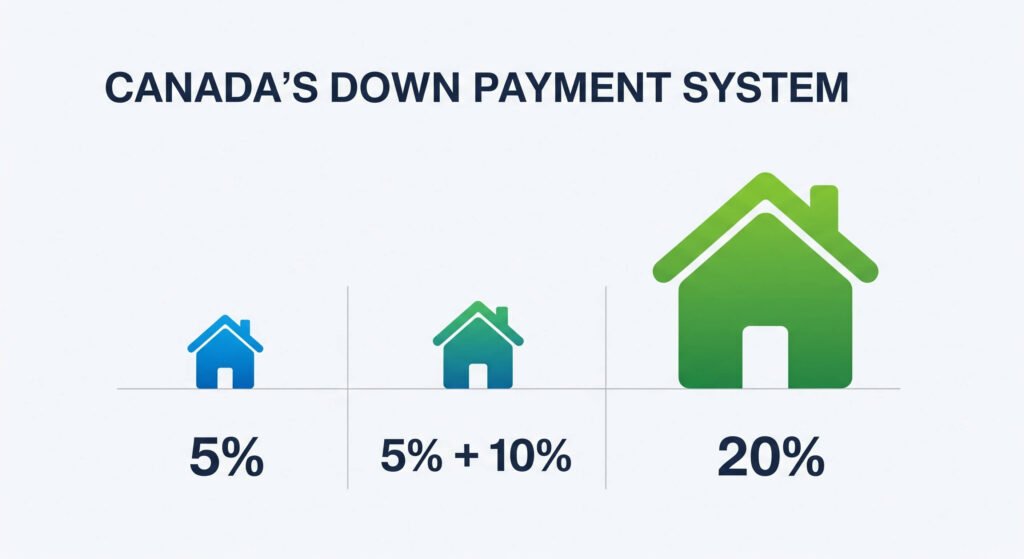
- For homes with a purchase price of $500,000 or less: The minimum required down payment is 5% of the purchase price.
- For homes with a purchase price between $500,001 and $1,499,999: The minimum down payment is calculated in two parts: 5% on the first $500,000 of the purchase price, plus 10% on the portion of the value above $500,000.
- For homes with a purchase price of $1,500,000 or more: The minimum required down payment is 20% of the purchase price. These properties are not eligible for mortgage default insurance, which is the tool that makes lower down payments possible. It's worth noting that this upper limit for insured mortgages was recently increased, providing more flexibility for buyers in more expensive markets.
Putting it into Practice: Down Payment Calculations
These rules can seem abstract in writing, so let’s look at some concrete examples. The tiered calculation for homes over $500,000 is where many people get confused, but it’s straightforward once you see it in action.
A critical point to understand is that for any home priced above $500,000, your minimum down payment as a percentage of the total price will always be more than 5%. As the home’s price increases, this “effective down payment percentage” gradually climbs. This is a subtle but important feature of the system, designed to ensure buyers have progressively more “skin in the game” as they purchase more expensive properties. Seeing this illustrated helps manage expectations and prevents the surprise of realizing you need more than a simple 5% for that home you have your eye on.
The following table demonstrates how to calculate the minimum down payment for various price points and reveals this sliding scale.
| Purchase Price | Calculation | Minimum Down Payment | Effective Down Payment % |
|---|---|---|---|
| $450,000 | 5% of $450,000 | $22,500 | 5.00% |
| $750,000 | (5% of $500,000) + (10% of $250,000) = $25,000 + $25,000 | $50,000 | 6.67% |
| $990,000 | (5% of $500,000) + (10% of $490,000) = $25,000 + $49,000 | $74,000 | 7.47% |
| $1,600,000 | 20% of $1,600,000 | $320,000 | 20.00% |
As the table shows, a buyer purchasing a $750,000 home needs a minimum of $50,000, which is 6.67% of the total price, not 5%. Understanding this nuance is the first step to building a realistic savings plan and confidently navigating the Canadian mortgage landscape.
- Understand mortgage payments – Mortgage Calculator
- Understand your mortgage qualification – Mortgage Qualifier
Your Secret Weapon: How Mortgage Insurance Actually Helps You Buy a Home
If the government requires a minimum 20% down payment for a conventional mortgage, how is it possible to buy with as little as 5%? The answer lies in a powerful tool called mortgage default insurance (MDI), sometimes referred to as mortgage loan insurance or CMHC insurance.
Understanding MDI is the key to unlocking the low-down-payment path to homeownership.
What is Mortgage Default Insurance (MDI)?
In the simplest terms, MDI is an insurance policy that protects your mortgage lender—not you—in the event you are unable to make your mortgage payments and default on the loan. By law, federally regulated lenders cannot provide a “high-ratio” mortgage (one where the down payment is less than 20%) unless it is insured against default.
While you, the borrower, are the one who pays for this insurance, the direct and most significant benefit is for you. This insurance gives the lender the security and confidence they need to approve your mortgage with a much smaller down payment than would otherwise be possible. Essentially, it’s the mechanism that bridges the gap between the 5% you have and the 20% the lender would traditionally require for an uninsured loan.
In Canada, there are three providers of this insurance:
Canada Mortgage and Housing Corporation (CMHC): A federal Crown corporation and the most well-known provider.
Sagen: A private mortgage insurer, formerly known as Genworth Financial.
Canada Guaranty: Another private mortgage insurer.
Your mortgage professional will work with these insurers on your behalf to secure the necessary coverage when you apply for a high-ratio mortgage.
The Cost of Access: Understanding the Premium
This access to homeownership comes at a cost, known as the MDI premium. This premium is not a flat fee; it is calculated as a percentage of your total mortgage amount. The specific percentage is determined by your Loan-to-Value (LTV) ratio, which is simply the mortgage amount divided by the purchase price of the home. It’s the inverse of your down payment percentage.
The logic is straightforward: a smaller down payment means a higher LTV ratio, which represents a greater risk to the lender and insurer. Therefore, a higher LTV results in a higher insurance premium. The premium rates are standardized across CMHC, Sagen, and Canada Guaranty for most standard mortgage products.
The table below shows how the size of your down payment directly impacts the premium you will pay (use CHMC Premium Calculator for the exact premiums)
| Down Payment (% of Home Value) | Loan-to-Value (LTV) Ratio | Insurance Premium (% of Mortgage Amount) |
|---|---|---|
| 5% to 9.99% | 90.01% to 95% | 4.00% |
| 10% to 14.99% | 85.01% to 90% | 3.10% |
| 15% to 19.99% | 80.01% to 85% | 2.80% |
| 20% or more | up to 80% | Not Required (unless specifically required by the lender for other risk factors) |
For example, on a $400,000 home with a 5% down payment ($20,000), your mortgage would be $380,000. The MDI premium would be 4.00% of that mortgage amount, which comes to $15,200.
How You Pay For It (The Two Costs)
There are two primary ways to handle this premium cost:
Pay it as a lump sum: You can pay the entire premium in cash at closing, along with your other closing costs. However, since this can be a substantial amount, this option is less common.
Add it to your mortgage principal: The most common method is to roll the premium into your total mortgage loan. In our example above, the $15,200 premium would be added to the $380,000 mortgage, making your new total mortgage principal $395,200. You then pay it off gradually as part of your regular monthly mortgage payments over the life of the loan.
However, there is a critical and often overlooked “gotcha” cost that every low-down-payment buyer must be aware of. In certain provinces—specifically Ontario, Quebec, and Saskatchewan—Provincial Sales Tax (PST, QST, or HST) is charged on the MDI premium. This tax cannot be added to your mortgage. It must be paid in cash out-of-pocket on your closing day.
Let’s revisit our example of the $400,000 home with a $15,200 MDI premium. If that home were in Ontario, where an 8% PST applies to insurance premiums, the buyer would need to have an additional $1,216 ($15,200 x 8%) in cash ready for their lawyer on closing day. This is a perfect example of why working with a knowledgeable mortgage professional is so important—to anticipate these hidden costs and ensure there are no stressful surprises when it’s time to sign the final papers.
The Trade-Off: Weighing the Pros and Cons of a Lower Down Payment
Opting for a down payment of less than 20% is a strategic trade-off. You gain earlier access to the housing market in exchange for a higher overall borrowing cost. There is no universally “right” or “wrong” choice; the best decision depends entirely on your personal financial situation, risk tolerance, and the conditions of your local real estate market. Understanding both sides of the coin is essential to making an informed decision.
The Pros: Getting in the Game Sooner
The advantages of a lower down payment are primarily centered around speed and flexibility.
Faster Market Entry: This is the single greatest benefit. Saving 5% or 7% of a home’s price is achievable much more quickly than saving 20%. In a rising real estate market, getting in sooner means you lock in a price today and benefit from potential appreciation, which can often far outweigh the cost of the MDI premium. It allows you to stop paying rent and start building your own wealth.
Start Building Equity Immediately: From your very first mortgage payment, a portion goes toward the principal loan amount, increasing your ownership stake in the property. This is a form of “forced savings” that builds your net worth over time, an opportunity that is missed while renting.
Increased Liquidity and Financial Flexibility: By committing less of your cash to the down payment, you retain more funds for other critical expenses. This includes closing costs (which can be 1.5% to 4% of the purchase price), moving expenses, furniture, necessary repairs or renovations, and, most importantly, a healthy emergency fund to handle unexpected life events.
Potentially Better Interest Rates: This may seem counter-intuitive, but it’s a crucial point. Because MDI fully protects the lender against default, high-ratio (insured) mortgages are considered very low-risk for the lender. As a result, lenders often offer their most competitive, lowest interest rates for these types of loans. In some cases, the interest rate on an insured mortgage with 15% down can be lower than the rate offered on a conventional, uninsured mortgage with 20% down.
The Cons: The Price of Convenience
The drawbacks are the financial costs and increased risks associated with borrowing more money.
The Mortgage Default Insurance Premium: This is the most direct and obvious cost. As calculated earlier, this premium can add tens of thousands of dollars to your mortgage loan, increasing the total amount you owe.
Higher Total Interest Paid: Since the MDI premium is typically added to your mortgage principal, you will pay interest on the premium for the entire amortization period. Over 25 years, this extra interest can add up to thousands of additional dollars, increasing the total cost of borrowing.
Higher Monthly Payments: A larger total loan amount (mortgage principal + MDI premium) naturally leads to higher monthly mortgage payments compared to a scenario with a 20% down payment, all else being equal. This reduces your monthly cash flow.
Slower Equity Growth and Higher Risk: Starting with less equity means it takes longer to build a substantial ownership position in your home. It also leaves you more vulnerable to market fluctuations. If property values were to decline shortly after you purchase, you could find yourself in a “negative equity” or “underwater” position, where you owe more on your mortgage than your home is worth. This can make it difficult to sell or refinance your home until the market recovers.
This balance of pros and cons leads to a fascinating strategic question that savvy homebuyers should consider with their mortgage advisor. If you have 20% saved, should you put it all down? Or might it be better to put down 19.9%, pay the MDI premium, but potentially secure a lower interest rate? The answer requires a careful calculation. The savings from a slightly lower interest rate over a five-year term could, in some market conditions, offset a significant portion of the MDI premium cost. This isn’t a simple decision; it involves running the numbers for your specific scenario, weighing the immediate cost of the premium against the long-term savings of a lower rate. It highlights that the “best” down payment isn’t always the biggest one—it’s the one that makes the most financial sense for your goals.
Supercharging Your Savings: Tools to Build Your Down Payment Faster
Knowing that the down payment goal is more attainable than you thought is the first step. The next is using the powerful tools available to Canadians to help you reach that goal even faster. The federal government has created specific programs designed to accelerate down payment savings.
The First Home Savings Account (FHSA): The Best of Both Worlds
Launched in 2023, the First Home Savings Account (FHSA) is widely considered the single most powerful tool for first-time home buyers in Canada. It brilliantly combines the best features of an RRSP and a TFSA:
Tax-Deductible Contributions: Like an RRSP, any money you contribute to an FHSA can be deducted from your taxable income for the year, resulting in a tax refund.
Tax-Free Growth and Withdrawals: Like a TFSA, the investments inside your FHSA grow completely tax-free. When you withdraw the funds to buy your first qualifying home, the withdrawal is also completely tax-free.
You can contribute up to $8,000 per year, with a lifetime maximum of $40,000. If you and a partner are buying a home together, you can each open an FHSA, doubling your potential savings to $80,000 plus tax-free growth.
The Home Buyers' Plan (HBP): Using Your RRSP
The long-standing Home Buyers’ Plan (HBP) allows you to borrow from your own Registered Retirement Savings Plan (RRSP) for a down payment. As of the 2024 Federal Budget, the withdrawal limit has been increased significantly.
You can now withdraw up to $60,000 per person from your RRSP, tax-free, to put toward a qualifying home. A couple could potentially withdraw up to $120,000.
The funds must have been in your RRSP for at least 90 days prior to the withdrawal.
The withdrawn amount is not taxed, but it must be repaid to your RRSP over a 15-year period, starting the second year after the withdrawal.
For those with cash savings and available RRSP contribution room, a savvy strategy known as the “RRSP gross-up” can be employed. This involves contributing your saved cash to your RRSP, claiming the tax deduction, waiting the required 90 days, and then withdrawing the funds tax-free under the HBP. The tax refund you receive from the initial contribution can then be used to help cover closing costs, furnish your new home, or even make an immediate lump-sum payment on your new mortgage. It’s a powerful way to make your savings work twice as hard.
Traditional vs. Non-Traditional Down Payments
It’s important to know where your down payment funds can come from. The vast majority of lenders and insurers like CMHC and Sagen require a “traditional” down payment, which comes from your own resources (savings, TFSA, FHSA), a withdrawal from your RRSP under the HBP, or a non-repayable gift from a close family member.
However, the mortgage landscape is diverse. Some insurers, notably Canada Guaranty, offer specialized programs like the “Flex 95 Advantage.” These programs may allow for a borrowed down payment from an arm’s-length source, such as an unsecured personal loan or line of credit, for borrowers who have a strong credit history. While this option comes with higher insurance premiums and requires you to factor the new loan payment into your debt calculations, it provides another potential pathway to homeownership for those who qualify. This illustrates the importance of exploring all available options with a mortgage professional who understands the full range of products on the market.
The Conclusion: Your Path to Homeownership Starts Now
The journey to buying a home can feel complex, but it begins with a single, empowering truth: the 20% down payment is a myth for most Canadians. As we’ve seen, the real minimum requirement is a far more manageable tiered system, starting at 5% for homes under $500,000 and gradually increasing from there.
This accessibility is made possible by Mortgage Default Insurance—a tool that, while adding to your cost, is the very key that unlocks the door to the housing market years sooner than might otherwise be possible. The decision to use it involves a personal trade-off between entering the market quickly and minimizing your long-term borrowing costs. There are compelling arguments for both sides, and the right choice is unique to you.
Furthermore, powerful government programs like the First Home Savings Account (FHSA) and the updated Home Buyers’ Plan (HBP) are specifically designed to help you build your down payment fund faster and more efficiently than ever before.
The path to owning a home is not about meeting one single, intimidating number. It is about understanding the real rules, weighing the strategic trade-offs, and using the right tools to build a plan that fits your life.
Feeling more hopeful? The right down payment strategy depends on your unique situation. Let’s have a conversation to see what path is best for you.